
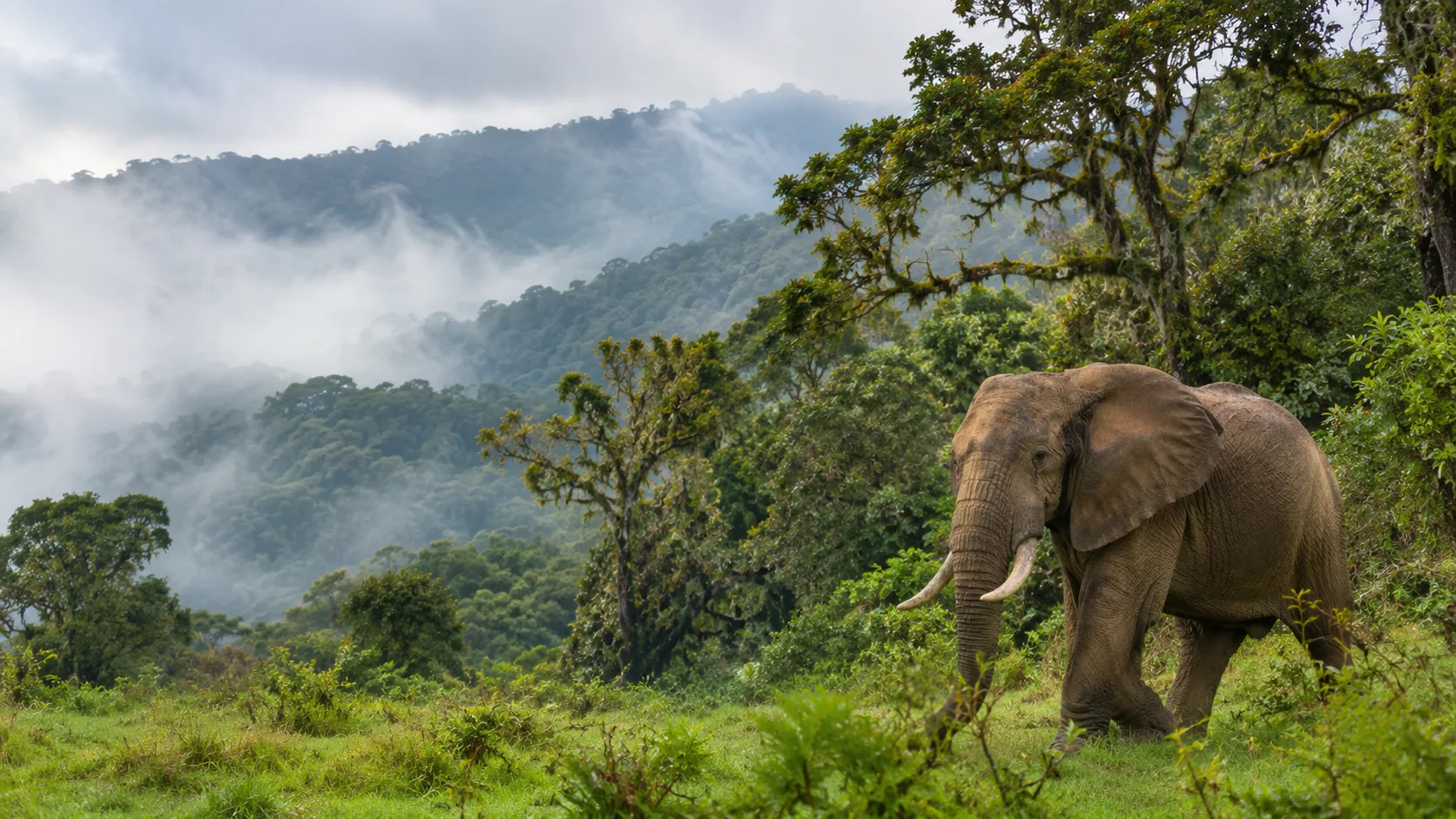
Misty highland rainforests, waterfalls and alpine moorlands
Covering 766 square kilometres along the dramatic volcanic ridge of the Aberdare Mountain Range in central Kenya, Aberdare National Park rises from roughly 2,000 metres in the forested Salient to over 4,000 metres on the windswept Afro alpine moorlands. Established in May 1950, the park offers a cool, atmospheric contrast to Kenya's sunlit savannahs: ancient podocarpus and cedar forests, dense bamboo thickets, deep V shaped ravines and cascading highland waterfalls shrouded in drifting mountain mist.
The park also holds a celebrated place in world history. In February 1952, Princess Elizabeth stayed overnight at the original Treetops Lodge overlooking a forest waterhole in the Aberdares when she received word of her father's passing and ascended to the throne as Queen Elizabeth II. Today, the park remains a vital water tower for central Kenya and a treasured refuge for elusive forest wildlife.
Elusive forest wildlife, black rhinos and highland birding
Wildlife viewing in the Aberdares rewards patience and keen eyes. African elephants and Cape buffalo are regularly encountered along forest glades and floodlit lodge waterholes, alongside spotted hyenas, bushbucks, waterbucks, warthogs, olive baboons, Sykes' monkeys and black and white colobus monkeys. The park is also famed for rare and secretive forest specialists: critically endangered eastern black rhinos in the Salient, giant forest hogs, African golden cats, servals, occasional melanistic (black) leopards and the elusive mountain bongo. Birders can search for over 250 recorded species, including Jackson's francolin, Hartlaub's turaco, crowned eagles, emerald cuckoos and vibrant alpine sunbirds.
Top activities and experiences in Aberdare National Park
Aberdare blends classic forest game viewing with dramatic highland hiking, waterfall circuits and quiet trout streams:
- Overnight tree lodge waterhole viewing: Watch elephants, buffaloes, giant forest hogs and nocturnal visitors gather at floodlit salt licks from elevated viewing decks and ground level photographic bunkers at iconic forest lodges.
- Spectacular waterfall circuits: Drive by 4x4 across the high moorlands to view Kenya's tallest single drop waterfalls, including Karuru Falls (dropping 273 metres in three dramatic tiers), Gura Falls, Chania Falls and Magura Falls (home to Queen's Cave).
- Highland moorland trekking: Guided day hikes and multi day treks climb scenic volcanic peaks such as Oldonyo Lesatima (4,001 metres), Kinangop Peak (3,906 metres), Table Mountain and the jagged spires of the Dragon's Teeth.
- Highland trout fishing: Cast for rainbow and brown trout along cold, clear mountain rivers such as the Chania, Gura and Amboni streams (valid KWS fishing permits apply).
- Forest game drives and bird photography: Explore the misty Salient tracks at dawn for elephants, colobus monkeys, waterfalls and moody rainforest compositions.
Where to stay in and around Aberdare National Park
Accommodation spans basic KWS mountain fishing cabins and campsites inside the moorlands to storied tree lodges and highland country estates just outside the gates:
- Budget and self catering stays: Inside the high moorlands, Kenya Wildlife Service operates simple self catering retreats such as KWS Fishing Lodge and Tusk Camp Bandas alongside public campsites (including Reedbuck and Ruhuruini). Nyeri town nearby also offers practical guesthouse value.
- Midrange lodges and country clubs: Just outside the park in Mweiga, explore Rhino Watch Safari Lodge (an intimate highland base positioned between Aberdare, Solio Game Reserve and Mount Kenya) or the classic heritage grounds of Aberdare Country Club, set on a 1,300 acre private wildlife sanctuary overlooking the Aberdare Range.
- Iconic forest tree lodge: Deep inside the park's forested Salient sits The Ark Lodge, designed like Noah's Ark with four viewing decks and a ground level bunker facing a bustling floodlit waterhole and salt lick (guests check in and lunch at Aberdare Country Club before transferring into the forest by lodge vehicle).
Combining Aberdare into a central Kenya safari circuit
One or two nights in the Aberdares adds a cool, green mountain interlude to a classic savannah safari. It sits directly along the scenic central highlands corridor linking Ol Pejeta Conservancy, Mount Kenya National Park, Samburu National Reserve and Lake Nakuru National Park. Explore our Kenya safari packages, family safari holidays or request a private tailor made central Kenya itinerary.
What makes this destination special
- Iconic tree lodge viewing: watch elephants, buffaloes and nocturnal forest wildlife at floodlit salt licks from The Ark.
- Dramatic highland waterfalls: marvel at 273 metre Karuru Falls, Gura Falls, Chania Falls and Magura Falls.
- Rare forest wildlife: habitat for black rhinos, giant forest hogs, colobus monkeys, melanistic leopards and mountain bongos.
- Afro alpine trekking: hike across misty moorlands to Lesatima Peak (4,001 m), Kinangop Peak and the Dragon's Teeth.
- Highland trout fishing and birding: clear mountain streams and over 250 highland forest bird species.
- Central highlands routing: pairs effortlessly with Ol Pejeta Conservancy, Mount Kenya and Lake Nakuru.
Best time to visit
Dry seasons from January to February and June to September offer the firmest 4x4 forest tracks and clearest waterfall views. Because highland rain and mist occur year round, pack warm fleece layers, waterproofs and sturdy shoes.
How to get there
By road from Nairobi: Located roughly 150 to 160 km north of Nairobi (typically 3 to 3.5 hours by road via Thika, Murang'a and Nyeri to the eastern gates). Primary access gates include Ruhuruini Gate, Treetops Gate and Ark Gate on the Nyeri and Mweiga side, Mutubio Gate on the western Naivasha and Kinangop side, and Shamata Gate and Wandare Gate on the northern Nyahururu approach. A 4x4 safari vehicle is essential for park moorland and waterfall tracks, especially after rain.
By air: Scheduled light aircraft flights from Nairobi Wilson Airport serve Nanyuki Airstrip (approx. 45 minutes), followed by a 1 to 1.5 hour road transfer to Mweiga and the eastern Aberdare gates, while private charters can also use Mweiga Airstrip or Nyaribo Airstrip near Nyeri.
Official park information and entry: Aberdare National Park is managed by Kenya Wildlife Service (KWS) (gates open daily 6:00 am to 6:00 pm; plastic free; 40 km/h speed limit; no off road driving). Conservation entry fees are paid cashlessly via the official KWS eCitizen portal; Eventide Safaris confirms all current fees, 4x4 routing and tree lodge transfer rules in your written quotation.
Why visit Aberdare National Park?
Choose Aberdare National Park for cool misty rainforests, Kenya's tallest waterfalls, floodlit tree lodge wildlife viewing and scenic highland hikes that provide a memorable contrast to open savannah game drives.
Where is Aberdare National Park?
Explore this destination's location in Kenya and the surrounding area.