
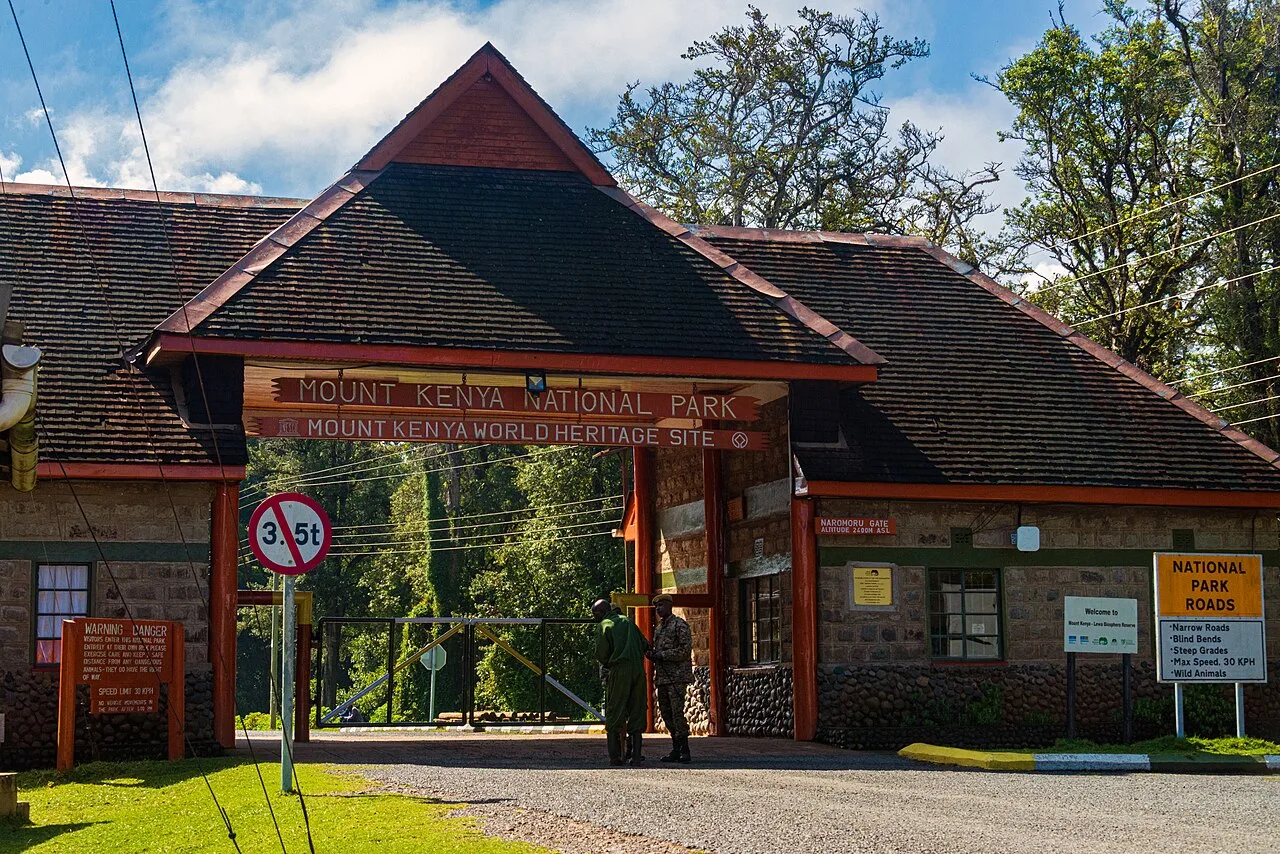
Africa's second highest mountain and UNESCO World Heritage landscape
Rising directly on the Equator in central Kenya, Mount Kenya is an ancient extinct volcano and Africa's second highest mountain, crowned by twin technical summits at Batian (5,199 metres) and Nelion (5,188 metres) alongside the premier non technical trekking peak, Point Lenana (4,985 metres). Established in 1949 and inscribed as a UNESCO World Heritage Site in 1997 (later extended to link with Lewa Wildlife Conservancy), the park protects roughly 715 square kilometres of dramatic alpine scenery surrounded by lush indigenous forest reserve.
What makes Mount Kenya extraordinary is how sharply its ecology transforms with elevation. Starting in cool montane rainforest and dense bamboo belts, trails climb into giant heather and misty Afro alpine moorlands dotted with giant lobelias, towering groundsels and glacial tarns before reaching jagged volcanic spires and retreating high altitude glaciers.
Wildlife, mountain bongo recovery and forest birding
While the upper alpine zone hosts rock hyraxes, augur buzzards, Lammergeyers and scarlet tufted malachite sunbirds, the lower montane forests harbour African elephants, Cape buffalo, leopards, black and white colobus monkeys, Sykes' monkeys, bushbucks, giant forest hogs and elusive mountain bongos. Because dense woodland limits open visibility, sightings reward patience and skilled local guides. Conservation organizations such as the Mount Kenya Trust work closely with Kenya Wildlife Service (KWS) on reforestation and wildlife corridors, while the Mount Kenya Wildlife Conservancy near Nanyuki leads a pioneering breeding and rewilding programme for critically endangered mountain bongos alongside an educational rescue centre.
Top activities and experiences on Mount Kenya
You do not have to be an extreme mountaineer to enjoy Mount Kenya. Experiences range from relaxed foothills outings to multi day high altitude expeditions:
- Point Lenana trekking (4 to 6 days): Ascend through distinct ecological zones on classic routes such as the scenic Sirimon Route (gradual northern acclimatization), the dramatic Chogoria Route (glacial lakes, Gorges Valley and Vivienne Falls), the direct Naro Moru Route, or quieter forest trails like Burguret and Kamweti. A 5 day Sirimon ascent with a Chogoria descent is widely favoured for scenery and safe acclimatization.
- Technical rock climbing on Batian and Nelion: Experienced alpine climbers with full technical gear and certified mountain guides tackle multi pitch rock routes on the main peaks during dry climbing windows.
- Day hikes and forest nature walks: Shorter guided walks around Sirimon Gate, Naro Moru, Castle Forest or Lake Ellis reward families and casual hikers with waterfall views, bamboo trails and highland flora without overnight camping.
- Mountain bongo and wildlife rescue visits: Visit the nearby Mount Kenya Wildlife Conservancy near Nanyuki to learn about forest antelope rewilding and orphaned wildlife rehabilitation.
- Highland trout fishing and birdwatching: Cast for rainbow and brown trout in crisp glacial streams and highland lakes such as Lake Rutundu and Lake Alice, or birdwatch for montane specialties including Hartlaub's turaco, Abbott's starling and olive ibis.
- Scenic helicopter flights and horseback riding: Luxury itineraries can include charter scenic flights over glacial tarns or gentle foothills riding around Nanyuki estates.
Where to stay on and around Mount Kenya
Accommodation spans basic mountain trekking huts and self catering forest cabins to storied foothills resorts. Eventide Safaris can arrange stays across every tier in your written itinerary:
- Budget stays, mountain huts and self catering: Trekkers sleep in mountain bunk huts and designated campsites such as Old Moses (Judmaier) Camp, Shipton's Camp, Mackinder's Camp and Chogoria's Mount Kenya Bandas. For comfortable self catering value inside the foothills, consider KWS Batian Guest House or historic rainforest cottages and camping on the southern slopes at Castle Forest Lodge.
- Midrange foothills lodges: Stay along a wooded mountain stream at Naro Moru River Lodge (the classic staging base for climbers and hikers) or enjoy peaceful garden cottages facing the mountain peaks at Soames Hotel just outside Nanyuki.
- Luxury resorts and remote alpine cabins: Explore our profile of Fairmont Mount Kenya Safari Club, a storied highland estate set directly on the Equator beside Mount Kenya Wildlife Conservancy. For secluded alpine wilderness at 3,080 metres, Rutundu Log Cabins offers cosy log retreats overlooking glacial Lake Rutundu with private trout fishing.
Combining Mount Kenya with a Kenya wildlife safari
Mount Kenya anchors central Kenya's highland and northern safari corridor. After a Point Lenana trek or two restful nights in Nanyuki, travellers transition effortlessly into Big Five game viewing at nearby Ol Pejeta Conservancy (45 minutes west), Lewa Wildlife Conservancy (1.5 hours north), Aberdare National Park, Samburu National Reserve or Meru National Park, with scheduled flights from Nanyuki directly to Masai Mara National Reserve. Browse our Kenya safari packages or ask Eventide Safaris to design a private mountain and wildlife itinerary matched to your fitness and travel dates.
What makes this destination special
- Africa's second highest massif: volcanic peaks rising to Batian (5,199 m), Nelion (5,188 m) and trekking summit Point Lenana (4,985 m).
- UNESCO World Heritage ecology: climb from montane forest and bamboo through giant lobelia moorlands to glacial tarns.
- Iconic trekking traverses: combine the gradual Sirimon ascent with the breathtaking Chogoria Valley descent.
- Mountain bongo conservation: visit Mount Kenya Wildlife Conservancy near Nanyuki to support rare forest antelope rewilding.
- Highland trout fishing and birding: cast in alpine streams and Lake Rutundu or spot montane endemics and raptors.
- Seamless Laikipia safari links: minutes from Ol Pejeta Conservancy, Lewa Wildlife Conservancy and Nanyuki Airstrip flights.
Best time to visit
Dry trekking windows run from January to March and July to October, offering clearer summit mornings and firmer trails. April to May and November bring heavier highland rain and mist; pack warm waterproof layers in every month.
How to get there
By road from Nairobi: Approximately 175 to 200 km north of Nairobi along the paved A2 highway via Thika, Karatina and Nyeri to Naro Moru or Nanyuki (typically 3 to 4 hours depending on traffic). Principal official access points are Naro Moru Gate (west), Sirimon Gate (northwest via Nanyuki, widely preferred for gradual acclimatization) and Chogoria Gate (east via Embu and Chogoria town, requiring a 4x4 on forest tracks).
By air: Daily scheduled light aircraft flights depart Nairobi Wilson Airport to Nanyuki Airstrip in approximately 45 minutes, with easy onward road transfers to Sirimon Gate, foothills lodges and neighbouring Laikipia conservancies (15 kg soft bag limits normally apply on scheduled flights).
Official park information and trekking rules: Mount Kenya National Park is managed by Kenya Wildlife Service (KWS), with cashless conservation fees paid via the official KWS eCitizen portal (multi day trekking packages carry distinct per day rates). Trekkers must use licensed mountain guides, carry appropriate cold weather gear and carry out all waste; Eventide Safaris confirms current official fees, guides and porter logistics in your written quotation.
Why visit Mount Kenya National Park?
Choose Mount Kenya National Park for world class equatorial alpine trekking to Point Lenana, dramatic glacial valleys, endangered mountain bongo conservation, peaceful foothills lodges and effortless pairings with Ol Pejeta and Lewa safaris.
Where is Mount Kenya National Park?
Explore this destination's location in Kenya and the surrounding area.
Where to stay around Mount Kenya National Park
Consider different comfort levels and locations when planning this part of Kenya. Every stay is subject to availability and a confirmed quotation.
Compare more accommodation for Mount Kenya National Park